Logical Agents
Summary of Logical Agents
Logical Agents
우리가 AI problem 을 setting 할때 Environments 가 항상 clear 한 것은 아니다. (당연) 그리고 자명하게 Agents 는 1인칭 시점에서 문제를 인식할 뿐, 전지적 작가시점은 아니다. 그래서 우리는 보이지 않는 부분을 위해서 logical 한 agents 를 구현하는 것이 중요하다.
Logcical Agent
Knowledge Base
공식 언어로 표현된 Sentences 의 집합 (A set of sentences in a formal language)로, 에이전트가 알고 있는 지식을 저장한다.
Inference Engine
domain 에 독립적인 알고리즘을 사용해 기존 지식으로부터 새로운 지식을 도출하는 역할
Knowledge Leve
Agent 가 무엇을 알고 있는지를 구현 방식과 상관없이 다루는 수준, Implementation Level 은 실제 데이터 구조와 알고리즘을 다룬다.
Basics of Logic
Logic 을 이해하기 위해서는 구문(Syntax), 의미론(Semantics), 모델(Model)의 개념을 알아야한다.
- Syntax : 문장이 어떻게 올바르게 형성되었는지 규정한다.
- e.g. \(x + y = 4\) 는 올바르지만, \(x4y+=\) 는 아님
- Semantics : 문장의 의미를 정의하며, 각 모델에 대해 문장의
True/False를 결정한다. - Model : 문장을 True or False 로 평가하는 Instance 이다.
- ** Satisfaction** : 모델 m 에서 문장 \(\alpha\) 가 참일때, “\(m\) 이 \(\alpha\) 를 만족한다” 라고 하며, \(M(\alpha)\)는 \(\alpha\) 를 만족하는 모든 모델의 집합을 의미한다.
- Entailment \(\alpha \models \beta\) : 문장 \(\alpha\) 가 True 인 모든 Model 에서 문장 \(\beta\) 도 반드시 True 이다. \(M(\alpha) \subseteq M(\beta)\)
Propositional Logic
Syntax and Semantics
Note
\(S_1 \implies S_2\) 는 \(S_1\) true, \(S_2\) false 일때만 false, 나머지는 항상 true
\(S_1 \iff S_2\) 는 \(S_1 \implies S_2\) 와 \(S_2 \implies S_1\) 가 모두 true일때만 true
Validity and Satisfiability
- Validity : 모든 모델에서 true 인 문장
- 문장 a 가 valid 하다 => \(a \equiv \text{True}\)
- Satisfiability : 적어도 하나의 모델에서 true 인 문장
- 문장 a 가 unsatisfiable 하다 => \(a \equiv \text{False}\)
Inference Methods
Knowledge Base 로 부터 Sentence \(\alpha\) 가 도출되는지 (\(KB \models \alpha\)) 확인하는 방법들이다.
Inference by Enumeration
모든 가능한 모델을 나열해서 \(KB\) 가 true 인 모든 경우에 \(\alpha\) 도 true 인지 확인한다. Big O is \(O(2_n)\).
Theorem Proving
모델을 생성하기 않고, Inference Rules를 직접 적용한다.
Validity
A sentence is valid if it is true in all models (e.g., \(P \lor \neg P\)). Valid sentences are also know as tautologies
Satisfiability
A sentences is satisfiable if it is true in some model. e.g., the expression \(P_1 \land P_2\) is satisfiable for \(P_1 = P_2 = true\), whereas \(P_1 \land \neg P_1\) is not satisfiable.
Modus Ponens
\(\alpha \Rightarrow \beta\) 와 \(\alpha\) 가 주어지면, \(\beta\) 를 추론한다.
\[\frac{\alpha \Rightarrow \beta, \ \alpha}{\beta}\]
And-Elimination
\(\alpha \land \beta\) 가 주어지면 \(\alpha\) 를 추론한다.
\[\frac{\alpha \land \beta}{\alpha}\]
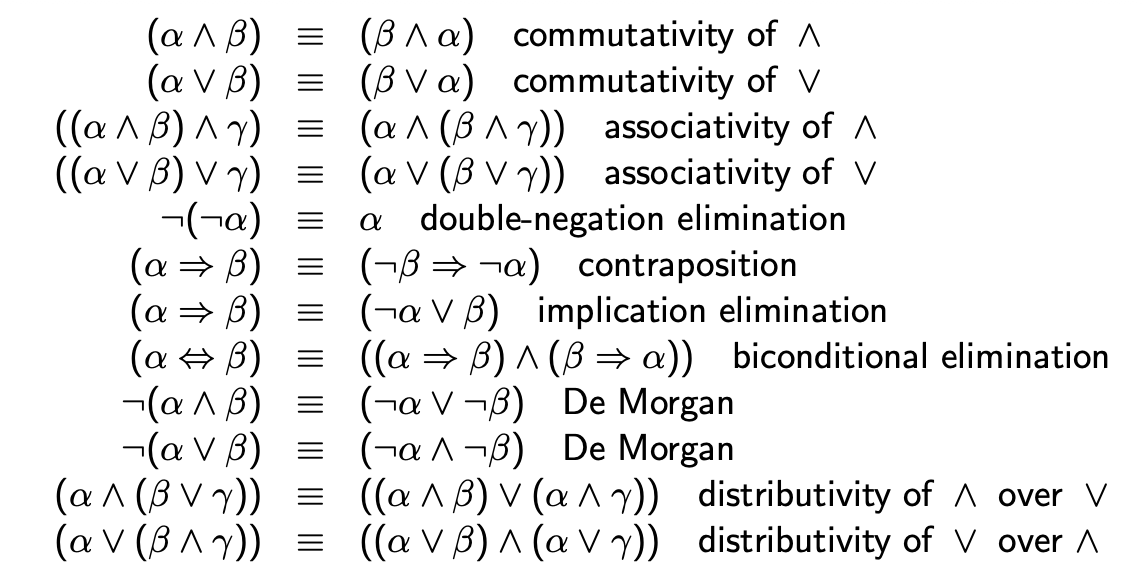
Logical Equivalence (\(\alpha \equiv \beta\))
두 문장이 동일한 모델 집합에서 true 일때 성립
Automated Theorem Proving
The previous method was done “by hand”. How can one automate this?
We can use the previously introduced search methods on the following problem:
- Initial state : the initial knowledge base
- Actioncs : all the inference rules applied to all the sentences that match the top half of the inference rule
- Result : the result of an action is to add the sentence in the bottom half of the inference rule
- Goal : a state that contains the sentence to prove.
In practical cases, finding a proof can be more efficient that enumeration because not all possible models have to be generated.
Resolution - 해 결합 (?)
Big Idea
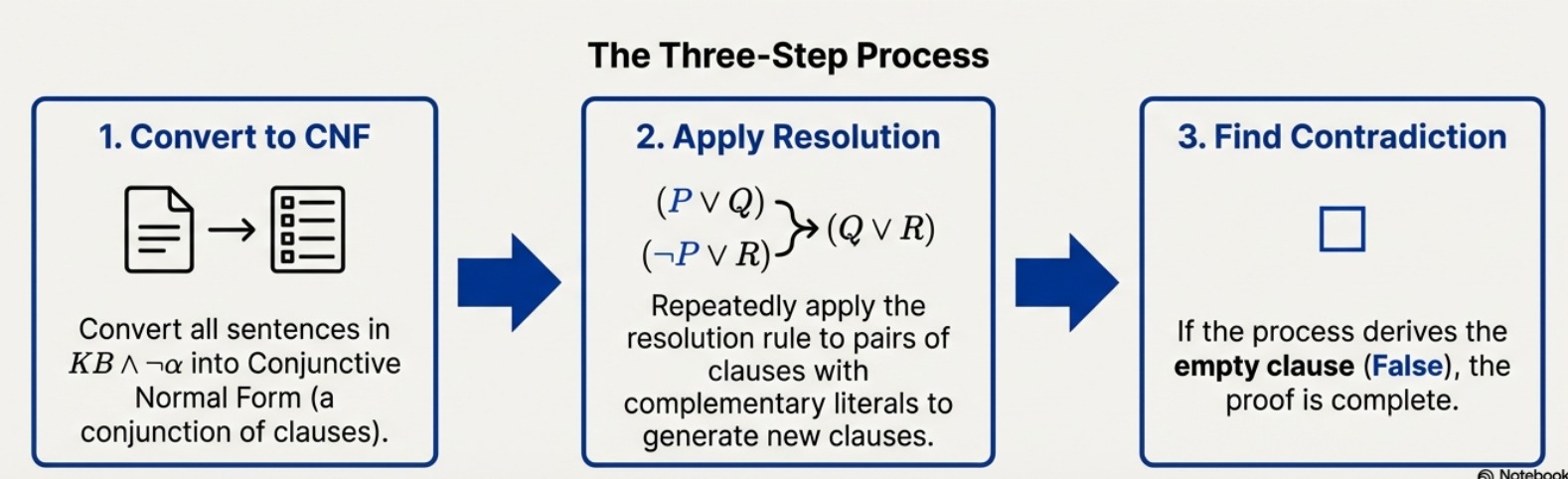
Resolution is a single, powerful inference rule that is sound and complete for propositional logic. It works via proof by contradiction.
The Strategy
To prove \(KB \models \alpha\), we instead prove that \(KB \land \neg \alpha\) is unsatisfiable. If \(KB \land \neg \alpha\) leads to a logical contradiction(
False), then our original goal (\(\alpha\)) must betrue
Resolution 은 Conjunctive Normal Form (CNF) 상태의 문장들에 적용되는 complete inference algorithm 이다.
Resolution Rule
\(l_1 \lor ... \lor \_k \text{ 와 } l_i, m_j\) 가 서로 complementary(보충적, e.g., \(P , \neg P\)) 일때, 이들을 제거하고 남은 literals(리터럴들)을 합친 새로운 절(Clause)을 만든다.
Conjunctive Normal Form
Literals 의 논리합(Disjunction)으로 이루어진 Clauses를 Conjunction 으로 연결한 형태로, 모든 명제 논리 문장은 CNF 로 변환 가능하다.
Proof by Contradiction
\(KB \models \alpha\) 임을 증명하기 위해, \(KB \land \neg \alpha\) 가 unsatisfiable 함을 보여준다. Resolution 을 반복 적용해서 empty clause 가 나오면 증명 끝.
Resolution 에는 아주아주 유명한 예시가 있는데, superman problem 이다. 거의 모든 로직 관련 수업에 등장하는 … 그런 예시
| Symbol |
|---|
| A: Able, W: Willing, P: Prevents evil, |
| I: Impotent, M Malevolent, E: Exists |
| Argument | KB |
|---|---|
| If Superman were able and willing to prevent evil, he would do so | \((A \land W) \Rightarrow P\) |
| If Superman were unable to prevent evil, he would be impotent | \(\neg A \Rightarrow I\) |
| If he were unwilling to prevent evil, he would be malevolent | \(\neg W \Rightarrow M\) |
| Superman does not prevent eval | \(\neg P\) |
| If Superman exists, he is neither impotent nor malevolent | \(E \Rightarrow (\neg I \land \neg M )\) |
| Therefore, Superman does not exists |
| Goal | Prove \(\neg E\) (Superman does not exists) |
| Proof Strategy | We will show that \(KB \land \neg (\neg E)\) which is \(KB \land E\) is unsatisfiable |
Step 1: Converting the Knowledge Base to CNF
Objective : Transform the single sentence \(KB \land E\) into a set of clauses.
Conversion Process
1. Eliminate Implications (\(\Rightarrow\)) : Replace \(\alpha \Rightarrow \beta\) with \(\neg \lor \beta\)
2. Move Negation (\(\neg\)) Inwards (De Morgan’s) : Replace \(\neg (\alpha \land \beta)\) with \(\neg \alpha \lor \neg \beta\)
3. Distribute \(\lor\) over \(\land\) : Replace \(\alpha \lor (\beta \land \gamma)\) with \((\alpha \lor \beta) \land (\alpha \lor \gamma)\)
이 방식으로 Clauses 를 정리하면 다음과 같다.
| KB | CNF | |
|---|---|---|
| \((A \land W) \Rightarrow P\) | 1 and 2; \(\neg (A \land W) \lor P\) | \(\neg A \lor \neg W \lor P\) |
| \(\neg A \Rightarrow I\) | 1 | \(A \lor I\) |
| \(\neg W \Rightarrow M\) | 1 | \(W \lor M\) |
| \(\neg P\) | \(\neg P\) | |
| \(E \Rightarrow (\neg I \land \neg M )\) | 1 and 3; \(\neg E \lor (\neg I \land \neg M)\) | \((\neg E \lor \neg I) \land (\neg E \lor \neg M)\) |
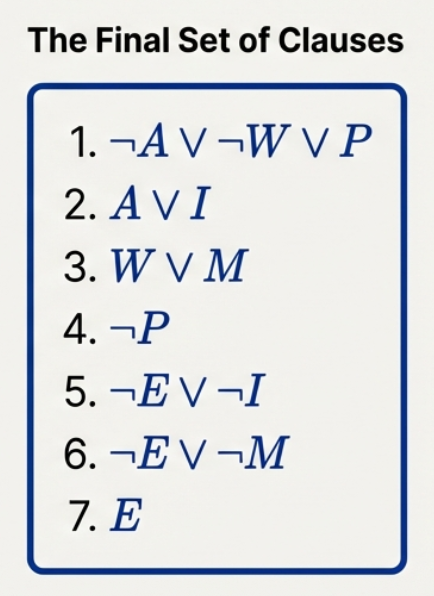
그럼 아래처럼 7가지 Clauses 가 나온다.
Step 2: The Resolution Proof
Objective : Repeatedly apply the resolution rule to derive the empty clause.
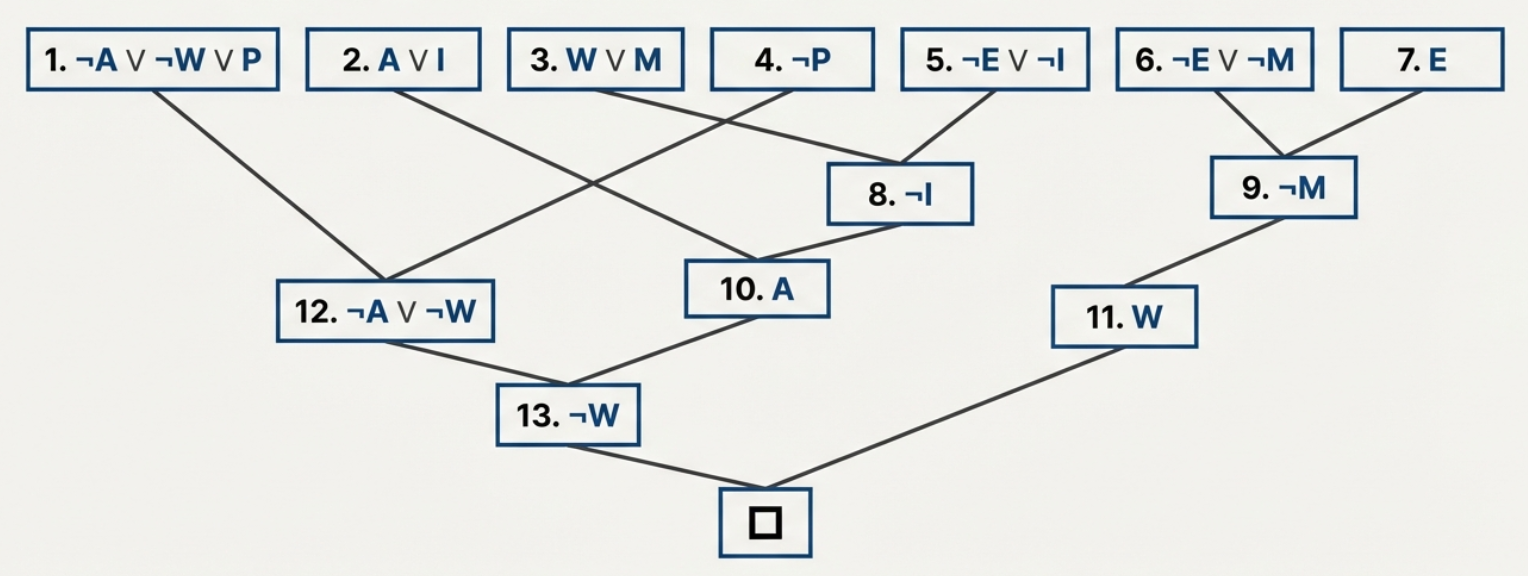
결론: The empty clause was derived, so \(KB \land E\) is unsatisfiable. Therefore, we have proven \(KB \models \neg E\).
Horn Clauses and Chaining
특수한 형태의 문장인 Horn Clause를 사용하면 매우 효율적인 추론이 가능하다.
Horn Clause
하나의 기호이거나, 즉 (기호들의 논리곱) \(\Rightarrow\) 기호 형태의 문장이다.
Horn Clause
- proposition symbol; or
- (conjunction of symbols) \(\Rightarrow\) symbol
A knowledge base consisting of Horn clauses only requires Modus Ponens as an inference method:
\[\frac{\alpha_1, ... , \alpha_n, \ \alpha_1 \land ... \land \alpha_n \Rightarrow \beta}{\beta}\]
Forward Chaining
Data-driven 방식으로, 알려진 사실로부터 시작해 만족되는 전제(Premises)를 찾아 결론을 추가해 나가는 방식이다.
Backward Chaining
Goal-driven 방식으로, 질의(Query)에서 시작해 이를 증명하기 위한 전제들을 거꾸로 찾아 올라가는 방식이다.
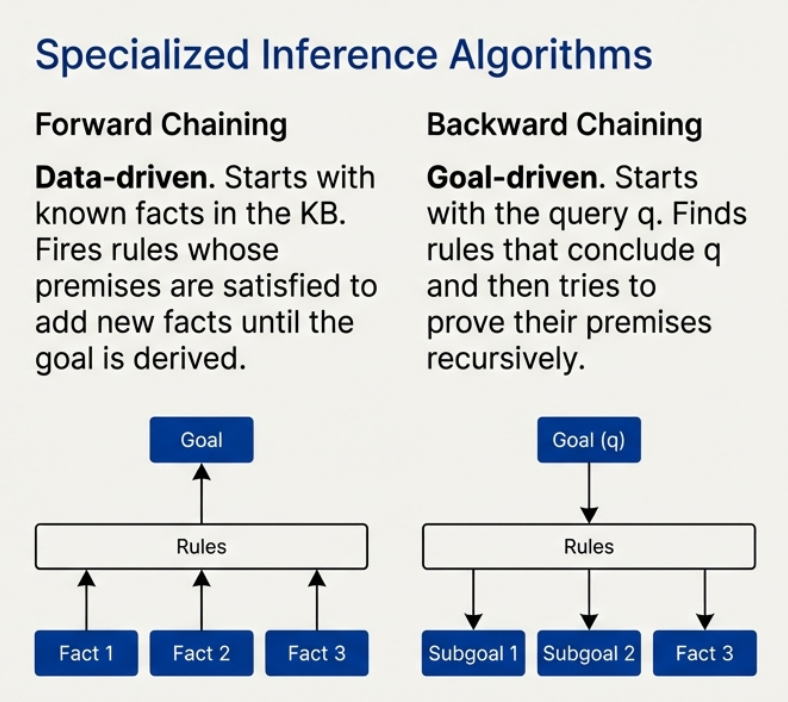
두 방식 모두 Linear 하다.
Soundness and Completeness
| Term | Description | Expression |
|---|---|---|
| Soundness | 추론 알고리즘이 도출한 모든 문장이 실제로 유도(Entailed)되는 경우 | $$KB \models \alpha \Rightarrow KB \models \alpha |
| Completeness | 실제로 유도되는 모든 문장을 추론 알고리즘이 찾아낼 수 있는 경우 | \(KB \models \alpha \Rightarrow KB \vdash \alpha\) |